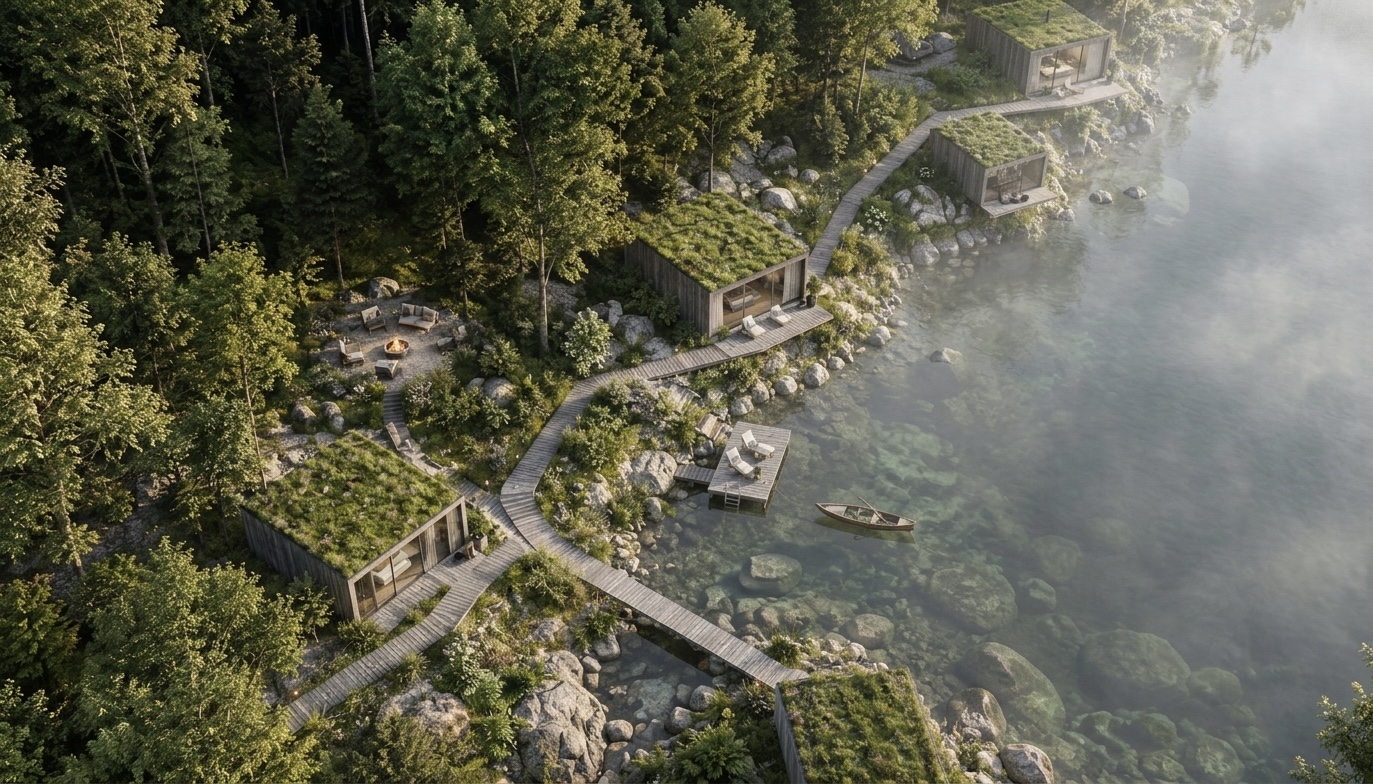
Most people who want to build a micro-resort begin with the cabin. They find a design they like, ask what ten of them would cost, and only then look hard at the land. It feels like progress. It is also the most expensive order in which to do things, because the questions that decide whether a resort works are answered by the site, the market, the planning system and the operator. The cabin comes last, and it is far easier to design once those answers exist.
This guide follows the sequence we use. It is written for landowners who have a site, or a strong candidate for one, and no background in hospitality development. If you already run hotels, the early sections will be familiar, though the parts on density and sequencing may still save you money.
A note on who we are, since it shapes the advice. EPIC Cabins is a development partner. We do the full-cycle development work, from land intelligence through to operations, and the client owns the result. We don't invest in or take ownership of the projects we develop. Our first resorts are in development and none has opened yet, so what follows comes from due diligence on real sites, including one we walked away from.
Step 1Ask the land first
Before you commission a design, a brand or a financial model, find out what the land will and won't allow. Four checks come first.
- Legal status. Ownership and title, zoning or land-use designation, any protected-area status, easements and rights of access.
- Physical constraints. Slope, soils, flood exposure, wildfire exposure, and how the site behaves in its worst season as well as its best.
- Infrastructure. Road access for delivery vehicles, a water source, wastewater options, and the distance to a grid connection, if one is needed at all.
- The cost of making it habitable. A beautiful site at the end of a long unmade track can carry a road budget that sinks the project before a single unit is placed.
These checks cost little compared with anything that follows. They are also where most bad projects should end.
We learned this directly. On a coastal site in the Caribbean, we checked the parcel's cadastral coordinates and obtained a certificate from the national environment ministry. Both confirmed that the land sat inside a strict nature reserve. No design could have changed that, so we walked away during due diligence, before any money went into drawings.
This is also the moment to record a baseline: what grows on the site, where water runs, what condition the soil is in, which species use it. If you want to say later that the resort left the land in better condition than it found it, you need a measured starting point. Without one, "regenerative" is a description you cannot prove. We cover this in more depth in What is a regenerative resort? and Reading the land.
Step 2Decide who comes, and why
A micro-resort sells a place, and every place has a catchment. The questions at this stage are commercial and specific.
- How far is the site from the guests who would pay for it, measured in hours of travel rather than kilometres?
- What do comparable properties in that catchment charge, and how full are they across the year?
- How long would guests stay, and what would they do on the second day?
- Which months are strong, which are weak, and what does the weak season cost you?
The answers set the price ceiling and the occupancy you can plan around. They also begin to shape the product. A site two hours from a capital city, sold mainly at weekends, needs a different unit mix and operating model from a remote site sold as a week-long stay.
Be wary of the answer you hope for. A landowner's view of the land is usually the most generous one in the room. The market's view is the one that repays the loan.
Step 3Let the land set the density
Every site has two numbers. The first is an ecological ceiling: how many units, guests and vehicles the land can carry without degrading the qualities that make it worth visiting. The second is an economic floor: how many units it takes to cover the fixed costs of running a resort, including staff, maintenance, marketing, insurance and reservations. The right unit count sits between the two.
Our working minimum is ten units. Below that, fixed operating costs are spread across too few keys, and the resort ends up relying on rates or occupancy that few markets sustain year after year. If a site's ceiling sits below its floor, the honest conclusion is that it is the wrong site for a resort, however beautiful it is.
Low density still matters. Space between units protects privacy, views and the landscape guests are paying to be in, and that is what holds the nightly rate up over time. Restraint in this sense is a ratio: fewer units than the site could physically hold, set against enough units to run as a business.
Our Unit Mix Optimizer is a quick way to test combinations of unit types before anyone commits to a plan.
Step 4Run a pre-feasibility study before you pay for design
A pre-feasibility study brings the first three steps into one document and adds a first view of cost, revenue and the planning route. Its job is to answer a single question: is this project worth the cost of a full feasibility study and design?
A useful one covers:
- a site summary, with the constraints and dealbreakers found so far;
- a market view, with target guests, comparable rates and a realistic occupancy curve;
- an indicative unit count and mix;
- an order-of-magnitude capital cost and a simple revenue model;
- the likely planning route and its timeline;
- the risks that could still end the project.
The most useful thing you can do before the study begins is write down what result would make you stop. A minimum return, a maximum capital commitment, a latest acceptable opening date. Set those while you are still neutral. Once the drawings exist, walking away becomes much harder.
For early numbers, our CAPEX Estimator, ROI Calculator and Payback Calculator give indicative ranges, and How much does it cost to build an eco-resort? explains which factors move the budget most. Treat all of them as the starting point for a study, never as a replacement for one.
Step 5Choose the operator and the capital before the design
First-time owners most often leave this step too late.
Who runs the resort changes what gets built. An owner who runs it personally needs different back-of-house space, staff accommodation and reception arrangements from an owner who appoints a management company or joins a brand. An operator will also have views on unit mix, food and drink, and the guest journey, and those views are cheaper to absorb on paper than after the foundations are in.
Money works the same way. Whether the project is funded from your own equity, with debt, or with a partner, the funder will want to see the feasibility work, the operating model, and who carries the risk if the opening slips. An undecided operator weakens every one of those conversations.
You don't need signed contracts yet. You do need a clear decision on the model (self-operated, managed or branded) and on how the capital is expected to be structured. Everything after this point is designed around those two answers.
Step 6Start the planning conversation early
For most micro-resorts, the calendar is set by permissions long before construction comes into it. Planning consent, environmental assessments, water and wastewater approvals and road access agreements can each take longer than the entire build.
A few habits help:
- Speak to the planning authority before you submit anything. Where pre-application discussions are offered, use them.
- Bring the baseline survey from step one. It shows the authority what is on the site now and what will change.
- Design the application around the constraints you already know about, rather than hoping they will be waived.
- Allow time for consultation with neighbours and the local community. Opposition that surfaces late is expensive.
How long does it take to build a modular resort? separates the fast part of the timeline from the slow part in more detail.
Step 7Masterplan the site, then design the units
With the land, market, density, operator and planning route settled, design finally has something solid to work from. Start with the whole site before any individual cabin.
A masterplan for a micro-resort decides:
- where each unit sits in relation to views, sun, wind, slope and its neighbours;
- how guests arrive, and what they see first;
- where service routes run, so housekeeping and maintenance stay out of guests' sight;
- where water, power and wastewater infrastructure goes, and how it is sized;
- where the land is left untouched.
Climate risk belongs here as a first-order input. Wildfire, flood and extreme heat affect the spacing between units, vegetation management, evacuation routes, drainage and material choice. Designing for them now costs far less than retrofitting later.
Only then do the units come into focus: their size, layout, terraces, orientation and materials. Our approach is timber-forward, and every design is made for its site and client rather than chosen from a catalogue. Walking through a spatial model of the resort is a much better test of a design than a set of renders, and Walk your resort before it exists explains how we approach it.
Step 8Build with the site in mind
Conventional construction on a remote site means months of trades, deliveries and weather exposure on the very land you are trying to protect. Factory-based construction moves most of that work indoors.
Our Plug&Live™ system is EU-based and BIM-driven. Units are 90–95% complete when they leave the factory, on-site assembly takes 2–7 days, and the foundations are relocatable. For a landowner, the practical effects are a shorter period of disturbance on site, fewer weather delays, and a clearer view of cost before construction begins.
Factory work does not remove the site work. Access roads, utilities, landscaping and any central buildings still need local contractors, and we use local labour and materials wherever the site allows. Built in place describes how that works in practice.
Step 9Plan the opening before the build finishes
A resort that is complete but not ready to open is an empty asset still carrying its financing costs. Pre-opening work should start well before the last unit is assembled:
- recruiting and training the team, ideally from the surrounding area;
- setting up reservations, distribution and pricing;
- building the brand and its story, which belong to you and to the place;
- a soft opening to test operations before full rates apply;
- continuing the baseline measurements from step one, so the first year has something to be compared against.
The first year of operation shows whether the assumptions in the feasibility study held. Track occupancy, rate, guest feedback and the ecological measures together, and review them against the thresholds you set in step four.
Before you beginWhat you need to start
Fewer things than most people assume. The title documents for the land, or a clear route to securing it. A rough sense of how much capital you could commit, and over what period. A view on whether you want to run the resort yourself. And a willingness to hear that a site should not become a resort, which is the most valuable answer a study can give when it is the true one.
FAQHow many units does a micro-resort need?
It depends on the site and the market. Our working minimum is ten units, because below that the fixed costs of operating rarely balance. The upper limit is whatever the land can carry without losing the qualities guests come for.
FAQHow long does it take to develop a micro-resort?
The build is the short part. Site studies, feasibility, planning and approvals usually take far longer than assembly, and their length varies widely by country and site.
FAQDo I need hospitality experience?
You don't, but the resort needs someone who has it. Decide early whether that is you, a management company or a brand, because the choice shapes the design.
FAQDo I keep ownership?
Yes. We work as a development partner: we carry out the development work, and the resort, its brand and its story belong to you.
If you have land and want to know what it could carry, start with Reading the land, or book a call.